
English| EUR
Suggested for you
More currencies
Choose a language
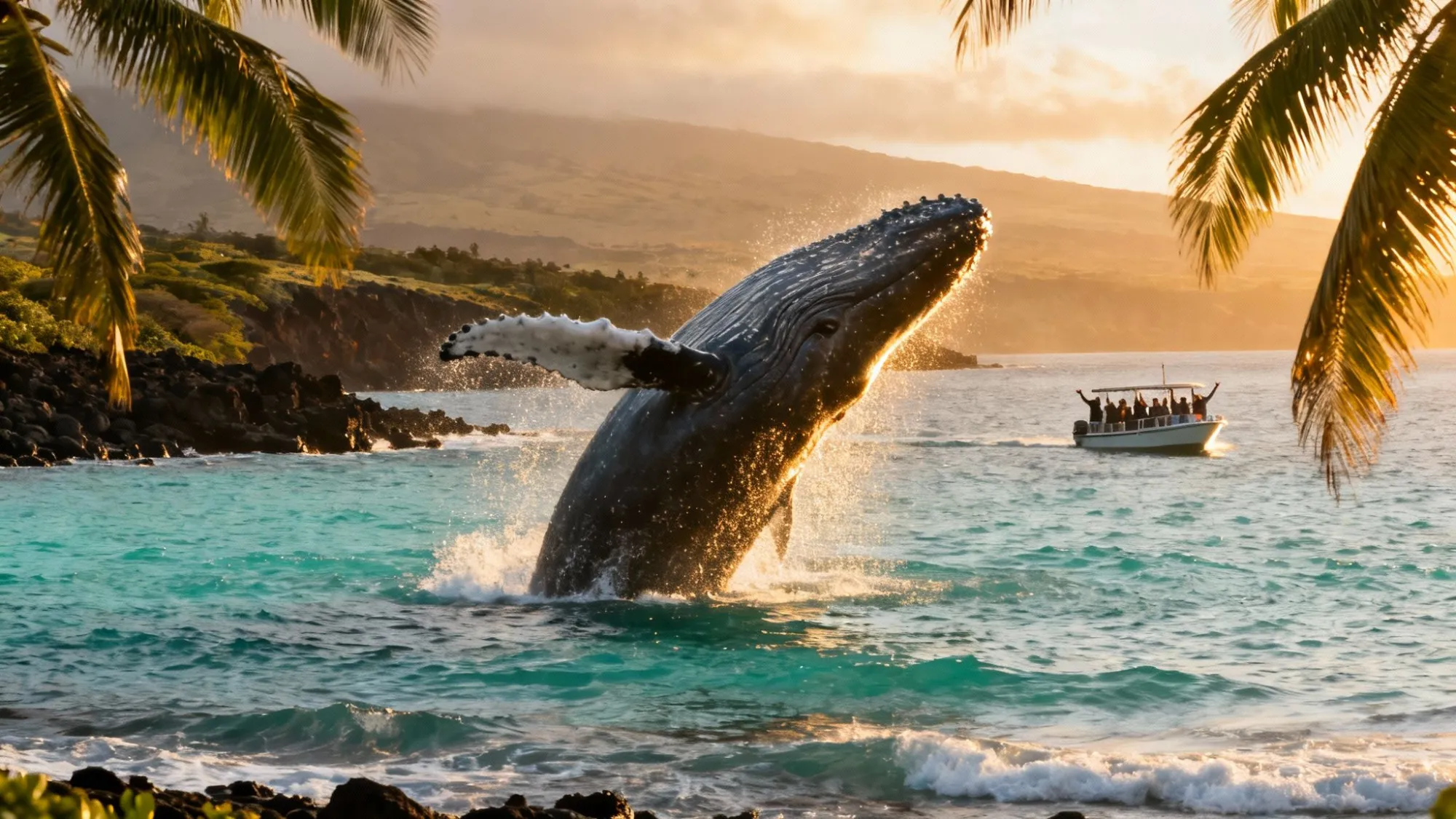
Every winter, humpback whales travel more than 3,000 miles from Alaska to the warm waters surrounding the Hawaiian Islands. Kona—and the neighboring Kohala Coast where Waikoloa sits—becomes one of the most reliable places in the North Pacific to observe these animals from land and sea.
Quick answer
Yes, you can see whales in Kona and along the Waikoloa coastline from mid-December through early April, with February and March offering the highest concentration of sightings. Humpback whales migrate to Hawaiian waters to breed and calve, and the protected bays along the Kohala Coast provide calm conditions that make surface behavior—breaching, tail slaps, pectoral fin waves—visible from shore. Anaeho'omalu Bay in Waikoloa offers free access and unobstructed sightlines during peak morning hours.
Humpback whales return to Hawaiian waters with the precision of a tide table, arriving in November and departing by May, but the question many visitors ask is whether Kona's geography actually puts you in their path. The answer hinges on understanding the difference between Kona proper—the busier southwestern shore centered on Kailua-Kona—and the Kohala Coast to the north, where Waikoloa sits. Both regions share the same migratory corridor, but the Kohala shoreline offers something Kona's commercial harbor district does not: long stretches of protected bay where whales linger in shallow water, close enough that binoculars become optional. Can you see whales in Kona without boarding a boat? Absolutely, and the Waikoloa area proves it. Anaeho'omalu Bay, locally known as A-Bay, provides one of the most accessible vantage points on the island. The bay opens directly onto the channel between the Big Island and Maui, a stretch of ocean that funnels migrating humpbacks into predictable lanes. Mothers with calves favor these protected shallows, and because the seabed rises gently, whales often surface within a few hundred yards of the beach. Breaches—the full-body leaps that send forty tons of whale into the air—are most common in the early morning, before wind chop obscures the surface. Pectoral slaps and tail throws, behaviors tied to communication and play, continue throughout the day. The North Pacific humpback population has grown steadily since commercial whaling ended in 1966, and current estimates place more than 10,000 individuals in Hawaiian waters each winter. Shore-based whale watching along the Kohala Coast requires no ticket, no reservation, and no entrance fee. The trade-off is distance: even a close whale is still a wild animal in open water, and a seventy-foot boat will always bring you nearer than sand ever can. But what you lose in proximity, you gain in duration. A morning at Anaeho'omalu Bay costs nothing, imposes no schedule, and lets you wait until the whales decide to show themselves. Spouts—the misty exhalation that marks a surfacing whale—become easier to spot with practice, and once you locate one, the animal's breathing pattern tells you when and where it will surface again. Most humpbacks breathe three to five times before diving, and that interval gives shore watchers enough time to reposition, focus a lens, or simply watch. The mechanics of migration explain why the Kohala Coast delivers consistent sightings. Humpbacks travel south not to feed—they eat nothing during their months in Hawaii—but to breed and give birth in water warm enough for calves to survive. The channel between islands acts as both highway and nursery, and Waikoloa sits at a bend in that highway where whales slow down. Viewing conditions peak between 07:00 and 10:00, when wind speeds remain low and the ocean surface stays glassy. By midday, trade winds roughen the water and reduce visibility, though whales continue their surface routines regardless of what humans can or cannot see.
“The channel between islands acts as both highway and nursery, and Waikoloa sits at a bend in that highway where whales slow down.”
Whale spotting opportunities span the entire western coastline of the Big Island, extending from Kona through to the Kohala Coast. Access to these waters is primarily facilitated by road travel along Highway 19, connecting the Kona area to the viewing hubs in Waikoloa.
Queen Ka'ahumanu Highway (HI-19) north from Kona
Hele-On Bus Route 75 to Waikoloa Beach Resort
Access points via Anaeho'omalu Bay, Waikoloa, HI 96738
For optimal shore-based visibility, arrive at Anaeho'omalu Bay between 07:00–10:00. This window offers the calmest water conditions before the daily trade winds increase.
Admission costs for whale watching in the Kona and Waikoloa area depend entirely on your chosen method of observation. While shore-based viewing is accessible at no cost, boat-based excursions are priced individually by independent operators.
Verdict: Shore-based viewing is free, while boat tour prices vary based on the specific operator and tour package selected.
Anaeho'omalu Bay remains open to the public daily for shore-based viewing activities.
Everything you need to know about can you see whales in kona
While visitors often ask can you see whales in kona, Waikoloa offers its own coastal vantage points for marine life observation. You can frequently spot migratory humpbacks in the deep channels between the islands during the winter months.
The peak season for whale activity in Hawaii typically runs from December through April. During these months, humpback whales migrate from Alaska to the warm Pacific waters to mate and give birth.
Shoreline spotting is possible, though a dedicated boat trip provides a better chance to see whales in kona area waters up close. Enthusiasts often scan the horizon from high points or beaches using binoculars to detect surface breaches or blows.
Organized excursions provide guided expertise and specialized vessels to reach deeper water where whales are more active. While can you see whales in kona from the shore, tours offer a higher probability of sighting behaviors like flukes and tail slaps.
The best arrival window is 07:00–10:00, as mornings offer the calmest water and best visibility before trade winds increase. Arriving early helps maximize your chances of spotting activity before the afternoon breeze creates whitecaps.
Yes, it is possible to sight whales from the coastline without a boat, though distance limits the view. Whether can you see whales in kona or Waikoloa depends largely on patience, weather conditions, and sea state.
For a boat excursion, bring polarized sunglasses, a camera with a zoom lens, and motion sickness medication if needed. Ensure you stay hydrated and use reef-safe sunscreen to protect the marine environment during your outing.